
Real Estate Strategy
Real estate managament is a diverse field where a clear strategy is needed to reach real estate protfolio targets. The owner or occupier is responsible for maintaining or increasing asset value, ensuring occupant satisfaction, improving sustainability and enhancing energy efficiency.
Our experienced real estate professionals partner with you to ensure you reach the desired targets for your real estate portfolio.
A solid real estate strategy sets the foundation for better management
A real estate strategy brings clarity and direction to real estate lifecycle management. It defines the key objectives and the steps to achieve them, ensuring your portfolio is managed in a sustainable, efficient and purposeful way for years to come.
Good strategy starts with knowledge. The right decisions are grounded in a clear understanding of where you are today and what the future holds.
Granlund – specialists in real estate management
We bring experience and expertise to strategy work in all its forms. Our consultants work with you on ownership principles, organisational models, processes and decision-making frameworks.
Our real estate professionals help you build a clear, manageable strategy for your property or portfolio – along with the processes needed to put it into practice. Our services can be tailored to your needs, from setting objectives to monitoring and reporting on results.
Who is our Real Estate Strategy service for?

Real Estate Investors
Build a profitable and sustainable real estate business.

Owner-occupiers
Make sure your property portfolio supports your core business.

Occupiers
Bring clarity to your space requirements and occupancy costs.

Public sector
Fit-for-purpose, functional and cost-efficient properties for the long term.
Real Estate Strategy as a service – how it works


Reporting
Current state assessment and strategic analyses
A solid real estate strategy is built on a clear understanding of your current situation and future needs. Our specialists carry out thorough assessments to lay the groundwork for a successful strategy.
- Asset data management strategy
- Property assessment
- Public service network assessment
- Strategy assessments
- Space utilisation assessment
- Due diligence
- Condition assessment
- Property tax assessment
- Maintenance backlog assessment
- Maintenance cost assessment


Defining strategic focus areas
A real estate strategy defines your identity as an organisation and the direction of your real estate lifecycle management.
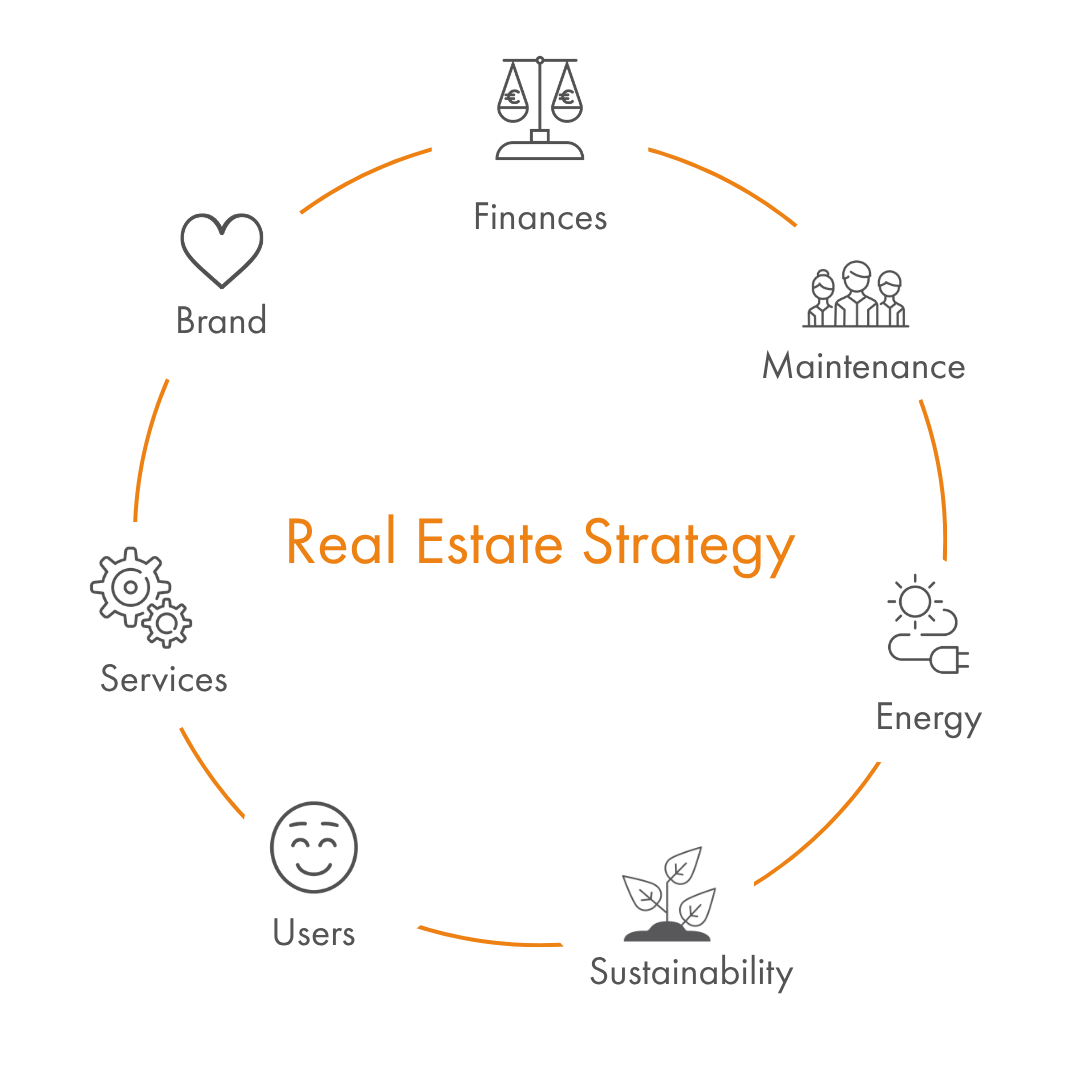
It sets out your core objectives: what returns you expect from your property or portfolio, what level of maintenance is right for you, which sustainability priorities matter most and how you attract and retain the right occupiers.
Properties and property owners often have a deliberately built brand. In some cases, the market perception has developed without a deliberate strategy.
Your strategy should define the kind of brand you want to build for your property or portfolio and what value proposition you offer. Are you a forward-thinking property owner offering the best modern offices, or a reliable provider of functional, affordable office spaces?
A real estate strategy can be divided into several components:

Maintenance Strategy
A maintenance strategy helps ensure that your property or portfolio is kept at the right standard and that day-to-day operations are moving in the right direction. It sets the target state against which everyday activities and processes are measured. Are occupier satisfaction and costs where you want them to be – and if not, what conclusions should be drawn and what actions should be taken?

Capital Planning Strategy
A capital planning strategy provides high-level guidance for decisions on repair projects and investments. What standard must be maintained? What level of maintenance backlog is acceptable? Are planned repair measures aligned with your sustainability strategy?

Sustainability Strategy
Real estate owners must be able to demonstrate to investors and occupiers that they operate responsibly and manage their environmental impact. Tightening regulation means that even smaller organisations need a credible sustainability strategy.

Workplace and Premises Strategy
A workplace or premises strategy ensures that the properties required for your business or organisation remain fit for purpose. It takes into account future operational changes, financial realities and long-term management objectives such as maintenance backlog targets.
Portfolio Segmentation
The criteria for portfolio segmentation are defined in your real estate strategy. The outcome is a clear picture of which properties are core to your operations, which require development and which should be disposed of over time. Segmentation ensures that maintenance backlog is managed at the right level across different real estate asset classes.
Portfolio segmentation by classification

Class A – Hold
Your most important properties: optimal location, strong financial performance and good technical condition. These assets have typically received significant investment and the aim is to keep them at a high standard.
Class B – Develop
Properties that are in good, safe and healthy condition, but whose future may be uncertain – for example, a major renovation may be on the horizon within a five-year window. Prioritisation is key for Class B assets.
Class C – Dispose
Properties earmarked for sale or demolition, due to factors such as unsuitability for their intended use, excessive maintenance backlog, poor location or high running costs.

Management systems and process development
A real estate strategy is only as good as the processes that support it. The processes needed to manage the strategy in practice are designed to serve the objectives set for operations, whether those are sustainability, cost efficiency, tenant satisfaction or growth in portfolio value.
When defining processes, it is essential to clarify not just the process itself but also responsibilities: who does what and when. Using digital systems to support processes ensures that information remains transparent, up-to-date and accessible.
Our real estate management specialists have broad expertise in process development and can also support implementation.
Examples of processes for putting a real estate strategy into practice:
- Data management process
- Capital planning process
- Maintenance process
- Sustainability roadmap

KPIs and reporting
Managing a real estate strategy requires comprehensive reporting that makes it easy to monitor targets and key performance indicators. Granlund provides high-quality reporting services to track how well the real estate strategy is being delivered.
Clear reports show whether the portfolio is moving in the right direction, covering both hard metrics such as financial figures and occupancy rates and softer indicators such as tenant feedback.
Benefits of a real estate strategy
- Lifecycle economics. Maintenance backlog management and operating costs are closely linked. Smart choices around energy efficiency can bring operating costs down.
- Operating costs. Keeping maintenance costs at the planned level and avoiding unwanted surprises.
- Occupant satisfaction. Ensuring the standard promised to tenants is maintained and occupants remain satisfied.
- Profitability. Striking the right balance between rental income and the services provided.
- Maintenance backlog. Keeping the backlog within the limits set by the strategy.
- Usability. Taking care of the basics: technical conditions and good indoor conditions.

Contact us

Susanna Sairanen